BLUF • THE SHORT ANSWER
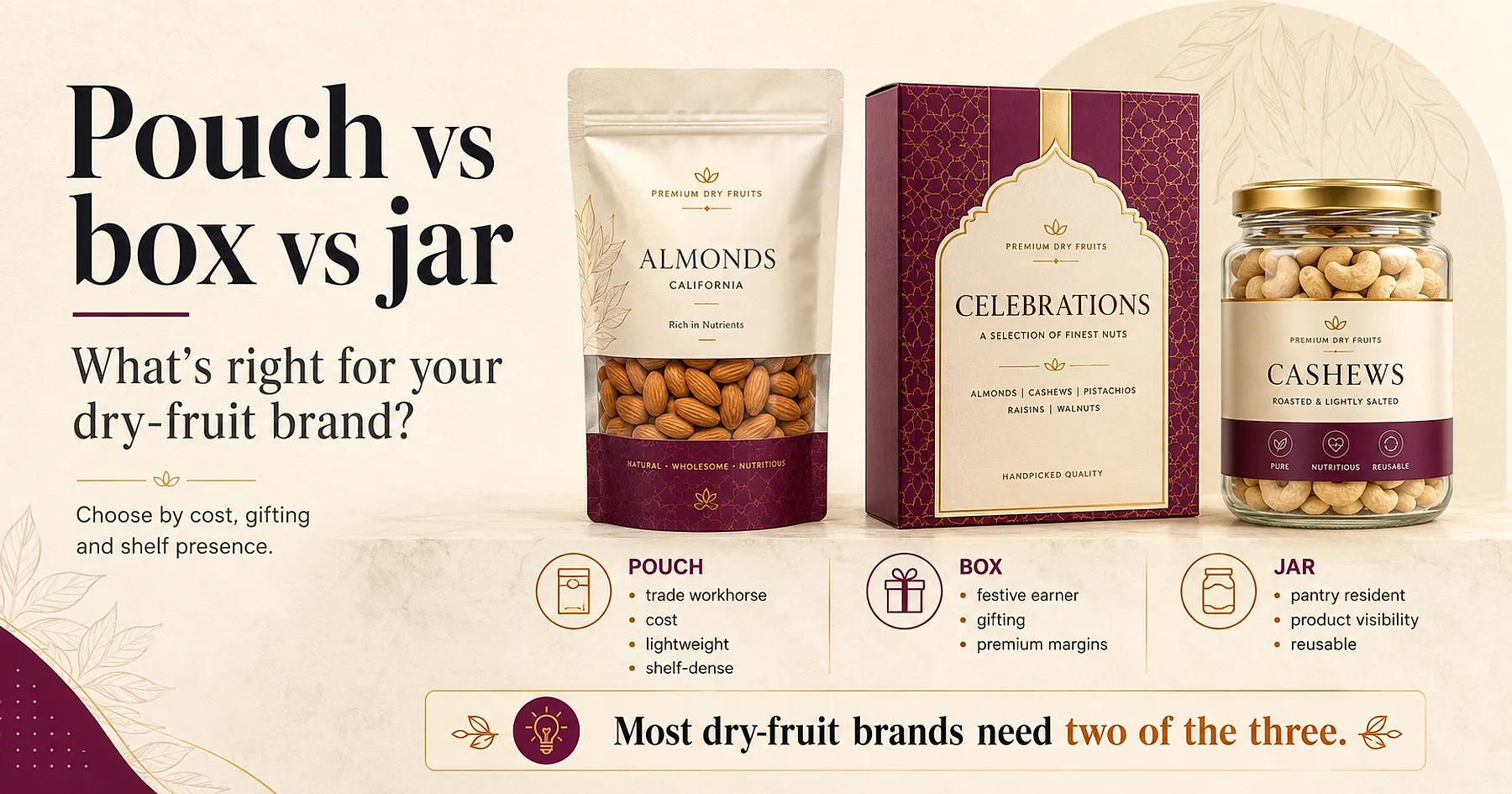
Pouches win on cost, weight and shelf density — your trade workhorse. Boxes win gifting, where dry fruits earn festive margins. Jars win the pantry: visible product, reusable pack, a brand that stays in the kitchen. Most dry-fruit brands need two of the three. Here's how to choose.
DZG • PERSPECTIVE
Walk any dry-fruit aisle: a wall of almonds, every pack shouting “premium,” most of them in the same gold-and-maroon costume. The format you choose decides your costs, your margins and your shelf presence before a single colour is picked. So choose like it matters.
The three-second test
A shopper gives the dry-fruit shelf about three seconds. In that window your pack must answer: what is it, why this one, and is it worth the price. Format sets the stage — a stand-up pouch reads everyday value, a rigid box reads gift, a glass-look jar reads pantry staple. Pick the wrong stage and even great design plays to the wrong audience.
The pouch — your trade workhorse
The stand-up pouch dominates dry fruits for good reasons:
- Cheapest per unit at almost any volume, and light enough to keep D2C shipping economics sane.
- Shelf-dense. More facings per foot of shelf — distributors and modern trade love it.
- Resealable zippers solve the freshness question shoppers actually ask.
The catch: a pouch has a premium ceiling. Past a price point, film feels like film. Foil layers, matte finishes and a disciplined front-of-pack push the ceiling up — but gifting money lives elsewhere.
The box — the festive earner
Indian dry fruits are a gifting category half the year. Diwali, weddings, corporate hampers — that’s box territory.
- Rigid boxes carry the highest margins in the category; the pack itself is part of the gift.
- Window cartons split the difference — structure plus product visibility.
- Trays, sleeves and inserts turn 400 grams of almonds into a presentation.
The catch: boxes cost real money, need minimum volumes, and sit heavy in e-commerce shipping. Run them as a festive line alongside your pouches, not instead of them.
festive season is won in september.
That’s not a slogan — it’s a print schedule. Boxes need structure sampling, finishes and press time. Brands that brief in September own November. Brands that brief in October apologise in November.
The jar — the pantry resident
PET jars are the quiet long-game format:
- The product sells itself — whole cashews visible through the pack beat any photograph of cashews.
- Reuse keeps you resident. Your jar holds the next refill, and your label sits in the kitchen for months. An ad they never throw away.
- Stackable, sturdy, kirana-friendly.
The catch: jars are heavy and bulky to ship, and the label is small — your brand has to work hard in a 6-centimetre band.
The decision matrix
Simple rules that survive contact with reality:
- Selling mostly D2C or quick-commerce? Pouch first. Shipping weight is a tax on everything else.
- Gifting over a quarter of your revenue — or you want it to be? Add a festive box line by September.
- Premium whole-piece SKUs (W180 cashews, jumbo medjool)? Jar — let the product do the talking.
- Launching with one format’s budget? Stand-up pouch with a zipper, designed with a family system that boxes and jars can join later. That last clause is the part most brands skip — and the reason relaunches cost double.
The compliance corner
Whatever the format: FSSAI license number, net quantity, MRP, batch and best-before, veg symbol, and Legal Metrology placement rules all apply — and they’re format-specific. A declaration block that fits a box lid won’t fit a jar band. Plan it at the dieline stage, not at the printer.
Deciding formats for your own range? That's a packaging-architecture question — send the brief and we'll scope it.
Get a proposal →— Harpreet
FOUNDER & CREATIVE DIRECTOR • DEZINO GRAPHIST • SINCE 2009